Showing posts with label Unit 31/3- Research for a new social action and community media production (P2). Show all posts

Monday, 21 October 2013

Task 2C- Audience research


Audience profile-
This is a PowerPoint presentation showing our audience profile. The audience profile is used to show who we are aiming our anti-bullying advertising campaign at, and talks about their gender, age, likes/dislikes, ethnic background, sexuality etc.

Friday, 11 October 2013

Task 2B- Primary Research


As a group we carried out primary research into the issue of bullying, and the current issues surrounding both the Beatbullying organisation and Bullying inside and outside of school. We carried out both a focus group, consisting of students aged between 13-16, and also we gave out around 40 questionnaires to sixth form students around school, mostly aged between 16-18. From the questionnaire we found out what young people would define bullying as, and also if they have ever been bullied, and what are the reasons that they believe that people get bullied.  We also asked them whether they knew about the organisation ‘Beatbullying.org’, and whether they had seen any anti-bullying campaigns.
From the focus group we had concluded information on what they would define bullying as. Also whether they had heard about the organisation, or used their website. From the focus group we wasn’t able to conclude as much information as the students were quite passive, and quiet in front of us, and therefore needed the teachers in the room to prompt them.
From carrying out this primary research it gave us an insight into what people believe that bullying should defined as. Also it allowed us to see whether many people had heard about the Beatbullying organisation, and whether they had used any of their services. From the feedback that we had gathered from both the questionnaire and the focus group we had concluded that not many people have heard about the Beatbullying organisation, and also that they have not seen many anti-bullying advertisements shown on TV at the moment.  
Therefore by creating an anti-bullying advertising campaign we are going to promote the Beatbullying organisation, and also bring the issue of bullying to the public’s attention.


Focus group results


Questionnaire results


Primary Research 24/10/13

Phone call:
As we wanted to find out more information on Beatbullying.org both me and Tayla decided to make a phone call to the Beatbullying press office.
When Tayla was making the phone call we wanted to find out whether we needed permission to use Beatbullying.org in our anti-bullying video production, and whether we could talk about what they do, and how they help young people who are being bullied. When asking them this they said that it was fine to talk about the organisation as long as we emailed them our finished video before we posted it on our blogs or anywhere else. We also wanted to find out whether they were able to send us a press package which includes information on the organisation, which they said that we were able to download it off their website.
Lastly, we wanted to find out if there was a representative from Beatbullying.org who we could go and interview either in person or on the phone, and record this interview which we would be including in our final production. In the interview we would be asking them questions about the organisation, and finding out from a representative working for the organisations point of view, rather than just finding out over the internet. Unfortunately they said that this was unlikely as it is currently anti-bullying week and everybody is very busy.
Email:
After making a phone call to the organisation, we also decided to email the Beatbullying press office. We firstly wanted to thank them for taking the time to speak to us over the phone, and answer all of the questions that we needed to ask them. Also we told them what we will include in our anti-bullying advertisement, and what we were going to talk about in relation to Beatbullying.org. We did this so that they were able to see everything that we was going to be talking about in our video, and that everything we were going to say about Beatbullying.org was positive, and we would include how they help young people who are being bullied.
We lastly asked them whether it would be possible to have an recorded interview with a representative from the company, although they had said that this wouldn’t be possible in the phone call we wanted to ask whether it would be possible later on in the year. Also we said that a phone interview would also be fine, however we have not heard back from them yet.
This is a copy of the email that we had sent:


Thursday, 10 October 2013

Task 1-Social action Media ideas

This is my mind map of ideas for my social action video production. This mind map is based around the issue of self-image, and how I will be incorporating it into my social action video production. It also includes both the advantages and disadvantages of my advertising campaign, and I have also spoken about two organisations which deal with the issue of self-image. By carrying out this research it will help me to then come up with a final idea with my group, and also to get a better understand of the organisations dealing with the issue of self-image. 


Task 2A-Secondary research on Beatbullying.org


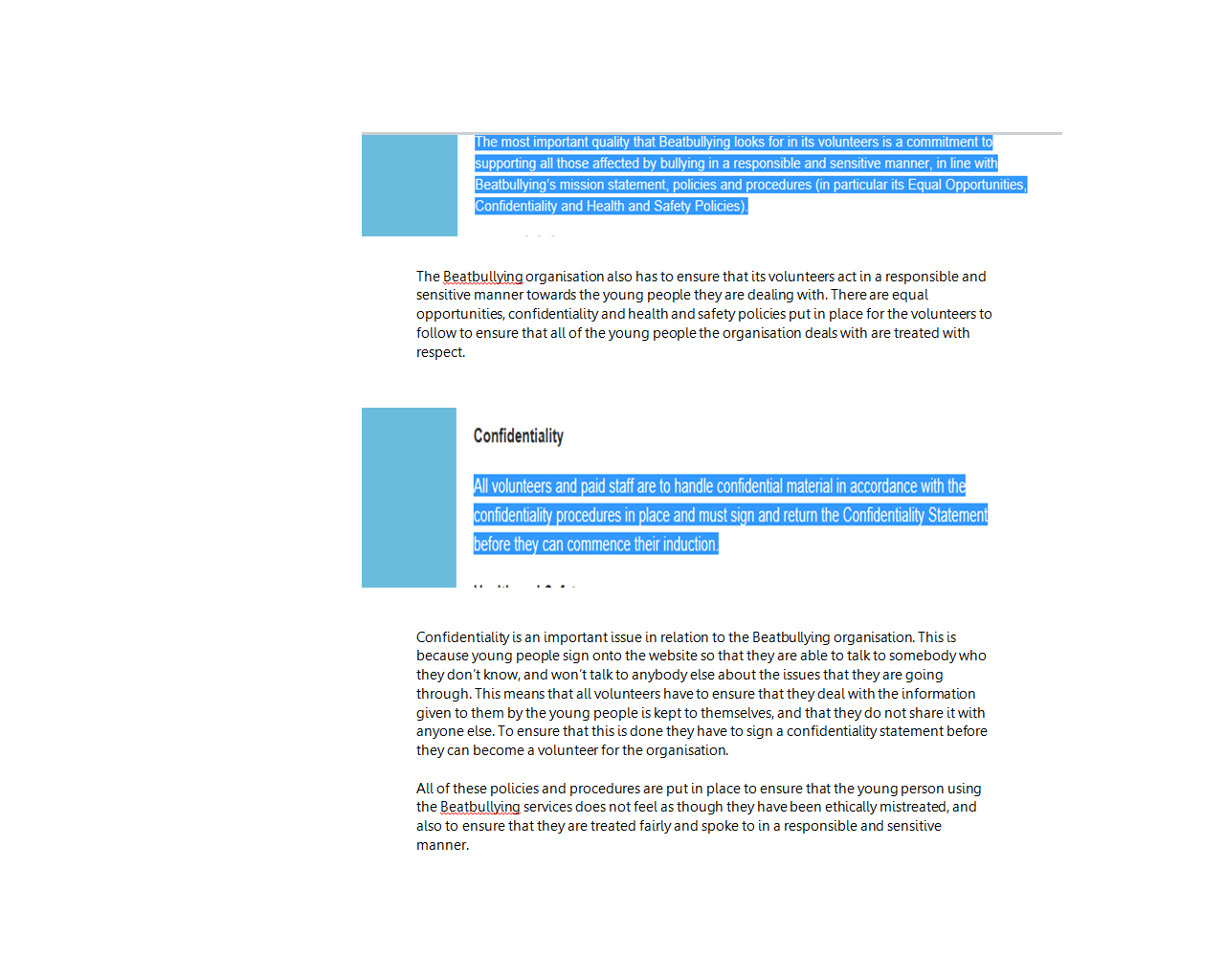
This is secondary research that I carried out about the organisation ‘Beatbullying.org’. This information is screenshots taken from the website about the organisation, what they do, which age group/gender they target and any statistics I could find on the organisation. Also I looked into the ethical considerations that the organisation have to take into place.
This information will help me as I have chosen the Beatbullying organisation to create an advertising campaign for, and therefore this information will help me get a better understanding of the organisation.


Beatbullying.org

-The issues and needs surrounding the organisation

The Beatbullying organisation needs are to assist and support young people that are being bullied, and to re-educate the behaviour of the young people who bully. Beatbullying looks to involve volunteers within the organisation to;
  1. ‘ensure that our services meet the needs of our children and young people across London, regionally and nationally;’
  2. ‘provide new skills and perspectives;’
  3. ‘Maintain and build on our links with the local community we serve.’
    http://archive.beatbullying.org/dox/working-at-BB/volunteering-policy-statement.html
-The Ethical considerations
When creating an advertising campaign ethical issues should always be taken into consideration, especially if the campaign is based on a sensitive issue such as bullying.
The organisation is extremely concerned about the welfare and safety of every young person that they work with. They believe that all children have the right to be safe, and their responsibility is to make sure that they are.
Beatbullying.org have both online and offline programmes, which provide a safe space, and an environment where people feel secure, valued, listen to, supported and are taken seriously. However, at all times the safety of the young person is their top priority. To ensure that this happens they have put in place training and procedures to support the Beatbullying staff, its counselling team, CyberMentors and Volunteer counsellors in their understanding of what they need to know and need to do in the event of a disclosure made by a young person either offline or online through the Beatbulling website.
Bullying is a clear safeguarding issue for young people in society today, and their mission states that they ‘strive to create a world where bullying, violence and harassment are unacceptable’. Although when working towards this goal the Beatbullying team come into contact with some of the most vulnerable young people in society today, and it is their duty as a anti-bullying children’s charity to support and assist them in the most responsible and professional way possible. BeatBullying works closely in partnership with agencies like CEOP (in the reporting of grooming and internet safety concerns) and Local Safeguarding Boards. Their approach towards these vulnerable young people is sensitive and consensual.
http://archive.beatbullying.org/dox/what-we-do/safeguarding.html
-How much money was raised through donations in the last campaign
As Beatbullying.org is a charity they get money through donations and fundraising. What your donation pays for;
£2.79
 pays for us to respond to one child that has been bullied. Last year there were 715,287 requests for help from very vulnerable children through cybermentors.org.uk
£13
 could keep the CyberMentor service online for another hour
£22
 could pay for a suicidal victim of bullying or child on child violence to talk online to one of our fully trained and qualified counsellors that are registered members of the BACP about their experiences for the first time
£100 
could pay for a child to train to be a CyberMentor, giving them the skills to help other children and young people who do not feel able to share their experiences of being bullied with an adult
£1,500
 could pay to run the CyberMentor programme for an entire year in your local school
£2,000,000 
could allow us to deliver the entire CyberMentor programme for one year providing critical life-saving support to at least 700,000 children and young people.
http://archive.beatbullying.org/dox/what-you-can-do/what-you-can-do.html
-How much work they have currently done on the issues
BeatBullying programmes are and have been independently evaluated by institutions and organisations such as New Philanthropy Capital, Sussex University and the Department for Education.
They have a range of bespoke anti-bullying programmes which are available to schools and groups for specialist issues;
-
Pupil Referral Units
-
Young Carers
-
Young Offenders
-
Young Travellers
-
Gangs
-
Looked After Young People
-
LGBT
-
Sexual Bullying
-
BMER
-
SEN
-
General Mental Health
-
Learning Difficulties
-
Whole School Approach
-
Independent/Boarding Schools
-
SureStart
-
Early Years
http://archive.beatbullying.org/dox/what-we-do/programmes.html
In the years since the organisation was founded they have delivered an exceptionally strong performance, starting from doubling their turnover year after year.
In 2009, the charity had a significant process of growth as they had increased their staff, volunteers, counsellors and CyberMentors.
They currently employ nearly
100 staff with 50 volunteer staff and over 3000 young people volunteering as CyberMentors.
http://archive.beatbullying.org/dox/home/financials.html


Books-
This is a Prezi presentation talking about the secondary information I had found from the two books, Bullying and Bullying in our society. Both of these books have given me the information that I needed to help with my final production.
Both of the books that I have looked at were based around the issue of bullying in young people, and talked about bullying both inside and outside of school. They both had a lot of detailed information, and gave me statistics and a definition of what bullying actually is.

Wednesday, 9 October 2013

Task 2d- Market Research


Market research:

Market research is a research method used to find out about the market and their customers. I am going to be conducting market research into the social action market to find out the size, competitors, and need for my social action TV production (advertising campaign). This will then help me to produce a production that will meet the needs of the market, will have the competitive edge and will be effective in promoting the awareness of the’ Beatbullying’ organisation and also the issue of bullying.  

What is the social action/community (Charity/not-for-profit) advertising market like?
The social action/community advertising market tends to be used by charities/organisations to promote awareness of their organisation, and also the issue that their organisation is surrounding. These organisations don’t tend to produce these campaigns for profit or fundraising needs, although some charities do. There are international charities which are set up to raise money for children living in third-world countries such as Africa. These charities try and play on the emotions of the public watching so that they are more likely, and feel as though they should donate money to the charity.


 What kinds/types of adverts are currently available?
There are many different types of social action/community adverts currently available to the public at the moment. There are advertisements put in place for both animals and humans, where they set out to promote the organisations and raise awareness of the issue surrounding it. In relation to the animal advertisements they tend to produce an advertising campaign to not only raise awareness, but to ask members of the public to donate to their organisation. There are many human advertisements which do this to, for example there are advertisements created to promote international charities which set out to help children from third-world countries. When creating their advertising campaigns they aim to play on the emotions of the public so that they are more likely to donate. They then use this money to help third-world countries, and also promote the organisation to a larger audience.
There is also advertising campaigns based around abuse in relationships, where it shows a boy banging against a glass as he sees himself abusing his girlfriend. This advert is used to promote abuse in relationships, and to also promote the organisation ‘This is abuse’ which helps to cut down on abuse in relationships.


What is the competition like?
The competition would be any organisation which are aimed at teenagers and is based on teenage issues, but the main competition against my advertising campaign would be anti-bullying adverts. There are many advertising campaigns which are based around teenage issues such as relationship abuse, alcohol abuse and drug abuse. The advertising campaign for the organisation ‘this is abuse’ was based around relationship abuse in teens. Although this advertising campaign would be competition against my advertising campaign as they are both aimed at teenagers, any anti-bullying campaigns which have been produced I would be competing with. The main competition which our advertising campaign will be up against is the ‘Diana Award’. This is because their aims and objectives are the same as ours, which is to cut down on bullying, and to promote the issue of bullying.
In this prezi presentation I have looked at the social action market where I have researched into two competitors of the organisation Beatbullying.org. This is going to help me understand the market, and make my production more competitive so that it is successful in the social action market.


Friday, 27 September 2013

Task 1- Research strategy


Research strategy/Proposal for Beatbullying.org television campaign


Idea Summery
We are going to be creating an advertising campaign for the ‘Beatbullying.org’ organisation to make the public aware of the bullying that goes on amongst children, and also that there are services which help children who are affected by bullying. Not only do we want to bring bullying to the public’s attention and the impact that bullying has on young children but we also want to bring the organisation to the public’s attention. This is because many children who are being bullied believe that they are alone and have nobody to talk to, but this organisation allows children to talk to mentors or other children about what they are going through, and also get help and advice.

Team members and research roles
We are going to be working in a group to create our anti-bullying advertising campaign.
The team members are;
Laura Fanning
Conall Murray
Keeley Bernarde
Tayla Davies-Lewis
As a group we are all taking on roles to carry out the research to create a television campaign for the organisation ‘Beatbullying.org’. Each member of the group will be carrying out both primary and secondary research, so that we can gather all the information that we need to ensure our advertising campaign is successful.

Audience research
As a group we will all be carrying out audience research to find out who we will be aiming our advertising campaign at. Audience research is important because it allows you to find out who you are aiming your production at; so that you can make sure that your audience is interested whilst watching, and understands what is going on in the advert.
There are many ways you could carry out audience research. You could firstly start by using primary research, which is research you gather and carry out yourself.
You would firstly use primary research to find out who to target the advertisement at. As bullying mostly occurs in teenagers you would firstly want to target them. Teenagers tend to go onto the internet a lot and access social networking sites such as Facebook and Twitter, I could set up a questionnaire on these social networking sites so that children would be able to fill them in. Also bullying occurs a lot on social networking sites, and therefore children may feel as though by filling in this questionnaire that they can get the impact of bullying to young children publicised and understood. When putting together the questionnaire I could use both closed and open ended questions, so that they can gather both qualitative and quantitative data.
When finding out what audience we would want to target for our advertising campaign we could also use secondary research. A secondary research method which we could use in relation to audience research is using internet research. As a group we could go online and research more into bullying, and the types of people and age groups who tend to get bullied.
I could also go to data gathering agency’s to find out what information they have already got together about bullying. Also we could go online to find out what the public’s views are on bullying. To do this we could set up on online poll with questions in relation to bullying, and then allow the public to fill it out. By doing this we could gather a lot of information from a range of people from different genders and age groups.

Market research
We would then need to research into market research, which is research you use to find out if there is a place in the market for your advertising campaign. There are also many different ways to carry this out, for example by using primary and secondary research.
In relation to primary research we could set up a questionnaire. This questionnaire will compose of questions about whether as an audience they believe there is a gap in the market for an anti-bullying campaign. When collecting this information I could put the information into both qualitative and quantitative data, by asking either both open or closed questions. By asking closed questions we would gather quantitative data, and this will therefore be easier to gather and conclude as all of the information will be in things such as charts or tally’s.
A research method which we could use to find out whether the advertising campaign would fit into the market is by looking on the internet at other advertising campaigns.
By doing this we would be able to see the way in which they have gone about promoting the different charities, or topics which people want to bring to the public’s attention. After looking at this we could then go on to taking ideas out of their campaigns which they had done well on, and the different things which had made the advertisement stand out. We would also want to make my advert different to all of the others, so that it stands out and is brought to the public’s attention.

Production research
We would finally have to carry out production research for our anti-bullying campaign. There are many things involved in the production of a television advert, such as choosing the right setting, writing the script, choosing the actors, the props and the costumes you want to use.
We would be mainly carrying out primary research, as we would need to visit locations and fill out location recce sheets to see if the locations are suitable. We would also be using secondary research, as we would be researching online to research into different people’s stories to write the script for the advert. We would need to do this to ensure that the storyline is as realistic as possible, and so that other people who are being bullied can relate to it.
We could also research into editing techniques and different camera work techniques; so that we could make sure our campaign looks professional and different to any other campaign which has already been shown. We would have to research into the different types of music and audio that we would want to use before we begin production. Also if we wanted to include statics in our production about bullying, and the amount of children who suffer from bullying or commit suicide from bullying each year we would have to research into these, so that we are able to get the correct statics from a trusted website.

Research issues

Our aims and objectives for this project is to create an anti-bullying campaign to raise awareness not only for bullying, but also for our chosen organisation. There shouldn’t be many issues to carry this out, although some people may not believe that bullying is an issue, and therefore wouldn’t understand the reason behind our campaign. Also they may not believe that our definition of bullying is right, and that some of the things that we class as bullying they wouldn’t. Another issue which could occur is that our chosen organisation do not want to get involved with our campaign and therefore we would have to find another charity who would want the awareness and recognition.
Social, personal and political issues;
There are many issues which could occur in relation to social, personal and political issues. The first issue which could occur is that people may feel embarrassed to tell us there story of any experiences they have had in relation to bullying. They may not want to give a detailed answer when asked questions from a questionnaire, and therefore we would not be able to conclude any qualitative data. The social issues regarding our anti-bullying campaign is that some people may not see bullying as an issue and therefore would not understand our aims to carry out this advertising campaign, and also may not want to accept our advertisement. There have been many political issues surrounding bullying, especially cyber bullying, in schools around the country. Therefore a lot of effort has been made to try and cut down on bullying in schools, and this means that people may pay attention and understand our advertisement.
Ethical considerations;
When creating an advertising campaign ethical issues should always be taken into consideration. When creating our anti-bullying campaign there could be many ethical considerations that we would have to make. For example it would be ethically wrong to show bullying in a good light, as it is an issue which affects many teenagers and this then may cause them distress and upset. We would have to make sure that throughout our advertisement we do not show any material which could be seen as ethically wrong and cause any harm or upset amongst the viewers. To do this we would have to ensure that we research into any ethical issues which could occur, or anything which could cause our target audience any harm or upset and ensure that we avoid doing these things.
Awareness of sensitivities around subjects;
When creating our anti-bullying campaign we would have to make sure that we research into issues which have recently occurred due to bullying. This is so that we know when producing our campaign or asking members of the public questions that we don’t discuss or talk about in too much detail any sensitive subjects which could cause people upset. Recently in the news there have been stories about teenagers committing suicide due to being bullied over the internet. Therefore as a group we will ensure that we do not ask detailed questions on this as it may cause upset amongst some people. As we want our storyline to be as realistic as possible we are going to want to research into real life bullying stories. To do this we may need to email, or interview people who have been bullied, and therefore when doing this we will have to ensure that the questions we ask does not cause that person to become upset as there would be many sensitive feelings around the subject.
Community resources and characteristics;
There are many resources that we could use to find out information needed for our campaign. As we are currently still at school we could ask and interview people at the school who may have had an issue with bullying, or know somebody who has been bullied. Also as the organisation that we want to create our campaign for is based in London, we could also go there and interview the founder, or people working for the organisation. This way we can find out first-hand what they do, and also the reasons behind setting up the organisation. We also have internet access at school where we can research more into bullying, and find out real life bullying stories which have been in the news, and also on the internet we can research more into the organisation.
Access issues;
As we live in the UK we could easily email, call or even visit the ‘Beatbullying’ organisation which is based in London. Also we can access the internet whilst at school and therefore research into bullying, and find out some bullying stories which we would want to include in our storyline. Although some websites on the schools computers do not allow you to access them and therefore some of the research will have to be carried out at home.
Existing comparable work;
When researching into bullying, and looking at different campaigns which have covered this I believe that it will be easy to find all of this information on the internet. This is because bullying is a topic which is talked about all over the internet and therefore there will be a lot of things we could look into. The only issue I believe that could occur is narrowing down all of this information, and picking out what we would use in our campaign. Also there have already been many advertising campaign based around bullying, and therefore we could research into and look at these and take ideas from what we believe worked well.
Funding issues;
As we are students we currently do not have a lot of money to fund for our advertising campaign. Therefore as this is a school production we would be able to get all the equipment needed to film our campaign from the school, and we would film the campaign somewhere where we wouldn’t have to pay to use it. Also the information that we are going to gather will be from the internet which we can access free of charge and carry out questionnaires ourselves and give them out to students around school and our friends and family. Therefore I believe that there will not be any issues in relation to the funding of our advertising campaign.
Opportunities for distribution and exhibition
;
When we have finished producing our advertising campaign we would then think about where we are going to show our campaign so that it could get as many views as possible. We would firstly want to put it onto Youtube, but before doing that we would have to look at any copyright issues which could occur. The school may also want to use our campaign to make students around the school aware of bullying. Finally we would want to show the ‘Beatbullying’ organisation so that they could show it on their website, to not only make people aware of bullying but also of their organisations. If they allow us to do so we would have to ensure that the people included in the advert are aware of this and that they have signed a disclosure form, which agrees to them being shown in our advertisement.